Monday, October 29, 2018

Mid90s: Nostalgically Peeking Into The Lives of 90s Youth Skate Culture


"You're off to watch a film directed by Jonah Hill?" Upon going to watch Mid90s, I was met with raised eyebrows and skeptical faces. The truth is, I was bursting with excitement. Seeing Hill in recent years tackle roles such as a Jesus-haired guru in Gus Van Sant's Don't Worry, He Won't Get Far On Foot, or more recently, the title character in the new Netflix drama, Maniac, he's proven he's come far and he's much more than just simply a funny guy from Superbad

After four years of writing Mid90s from the ground up, Hill hits us with his directorial debut, a homage to a period he grew up in. As he tells Business Insider, his goal was to always be a filmmaker. After years of paying attention to everything that happens on set, the lesson he learned was simple: don't do it until you have something to say.

The movie follows Stevie (Sunny Suljic), who is a 13-year-old living in Los Angeles in the mid-90s and has no friends. His family life is chaotic, with his mother (Katherine Waterston) working constantly and in her spare time has men coming in and out of her room. His older brother, Ian (Lucas Hedges in an almost unrecognizable role), beats him on the regular, yet Stevie still somewhat looks up to him, entering his room while he's away and looking at all his things. One day, Stevie wanders around his neighborhood and comes across a group of teens at a skate shop. Listening to them interact and skate, Stevie is suddenly hooked. He comes back daily, desperately yearning to be a part of the group. The film essentially follows this pack of kids during a summer, a quick glimpse into their lives when not much had meaning, except for their strong bond and, ultimately, the breath of life that skateboarding gives them. 


Since the movie is inspired by Hill's own youth and a time that is so dear to him, he pegs the era perfectly. His period-specific details are so spot on yet so subtle, it truly seems like you're watching a relic from the 90s. From Stevie's Teenage Mutant Ninja Turtles comforter to some Super Soakers, everything is immaculate. 

However, although the details are addictive and the audience watching is hungry for more easter eggs, Hill had a rule that he wouldn't do any "nostalgia porn." Although he included elements from the 90s, he didn't dwell on it much. When Stevie plays Super Nintendo, for example, we never get a glimpse of exactly what games are played. These touches would have made the movie cross into cheesy territory, and Hill isn't interested in that.

Another touch Hill gives the movie is having it shot with a Super 16-millimeter camera in 4:3 - the same aspect ratio found on old box TVs. This will bother some people, I personally loved it. What ends up feeling like digging up an old home film adds to the element of this movie being an artifact, a look at a simpler time.


The pièce de résistance, however, is the soundtrack, which Hill recognizes is the absolute DNA of the film. Weaving from A Tribe Called Quest, to a little known diddy by Hungarian band, Omega, to Morrissey, you don't expect the songs to blend so well together - but they do. As all coming-of-age movies, the soundtrack is utterly unforgettable. Scanning the audience, I noticed everyone was my age and grew up in the 90s. It suddenly hit me: this soundtrack would bring waves upon waves of nostalgia - and that's the point of Mid90s.

The first few moments of Mid90s immediately reminded me of Larry Clark's disturbing coming-of-age, Kids, which came out in '95. It was raw and disturbing, and the skating hooligans were brazen to the point where nothing mattered in their sad lives except drug use and lacking any sort of emotion at all. The nihilism in the teens was something never seen in a movie before, and while Hill admits he found some inspiration from the mid-90s gem, he wanted to make an anti-Kids, and give his characters some hope to keep going, as bleak as their worlds may be. That's just it, his kids aren't nihilistic. They have hope. 

While Clark's Kids was a look at a fraction of the urban youth in the 90s, Hill's film looks at the reality of most, making us beg the question: were children of the 90s even that bad? Unlike Kids, Jonah Hill remembers the 90s fondly, making us realize that it was a time even more innocent than that of which kids grow up in today - with the world at their digital fingertips.

While some people may finish the movie wondering what the point truly was, I found the lack of a concrete plot absolutely perfect. The point of the movie is the way it's made, the details and the nostalgic relics of adolescent youth, and most importantly, the soundtrack - which if it was a mixtape that these teens owned, they'd clutch to their hearts dearly. Hill achieves his purpose of capturing one lazy summer in these kids' lives,  where nothing else matters except their close bond and their boards. As one character so perfectly puts it, "That's why we ride a piece of wood. What that does to somebody's spirit." With that, Hill succeeds in putting together what he has to say and showing everyone he's a force to be reckoned with in filmmaking.
SHARE:

Saturday, September 29, 2018

'Matangi/Maya/M.I.A.' A Candid Look At The Scrappy Scandal-Magnet, Repeatedly Silenced By The Age of Celebrity


The most intriguing part of M.I.A's new documentary “Matangi/Maya/M.I.A." is that Maya, (birthname Matangi Arulpragasam), originally wanted to be a documentary filmmaker, having felt she had so much to share with the world. Before becoming the notoriously provocative English-Sri Lankan musician that we've all come to know, Maya was busy creating personal footage of her family and friends, both in London and Sri Lanka. Now, Steve Loveridge, one of her very dear friends from film school has made the Sundance-winning documentary about her, utilizing hundreds upon hundreds of hours of personal footage that Maya has accumulated from her youth to present day. This makes for a very personal profile that doesn't feel like propaganda made out to make you like her necessarily or to boost album sales (she hasn't released one since 2016).

Maya immigrated with her mother and siblings to London from Sri Lanka as a refugee from the civil war in the mid-1980s. Her father was the founder of the Tamil revolutionaries and stayed behind to fight, only coming later on the UK. She touches upon her love for Western hip-hop growing up and her trip back to Sri Lanka to film a documentary about her heritage and answer some questions about her own identity.

The concept of not belonging to either your native country nor the one you were brought up in rings true for me on a very personal level and will be sure to touch other immigrant youths as well. Feeling like she stood out in London, Maya goes back to Sri Lanka to make her film school documentary she was developing at the time. Upon coming back, she chats to family members, who remind her that she didn't go through the unrest and turmoil that surrounded their lives. She's yet again an outsider, confused about where she truly belongs. The idea of being a child of immigrant parents and dealing with the confusion of your own self-identity and heritage was a portion of the film that stood out, and I almost wish was touched upon even more, as it's a topic that's swept under the rug on a regular basis in the society we live in today. 


Coming back from Sri Lanka to London, Maya decides to incorporate elements of her heritage and roots into making a hip-hop mixtape and taking it to UK producers. The rest is history. With the hours of personal footage, early demos, and behind-the-scenes views of some of her ballsiest, most controversial moments in her career, you're left feeling a deep respect for this intelligent, well-spoken, and independent artist, and at times shocked at the way the media portrays her. Loveridge offers fantastic examples of this such as the visit from former New York Times writer Lynn Hirschberg, where she fawns over Maya's work then proceeds to write a scathing review on her, to all the times she's been labeled a terrorist sympathizer, or uneducated on the politics of Sri Lanka.

While some may not like that the film focuses on her formative years, it offers a look into the mind of an artist that people have been quick to discredit, making it only fair she gets to share her side of the story. A voice for the marginalized that understands the necessity of having a large platform and using it to talk about issues that will, if anything, educate the masses, M.I.A is finally given a platform to speak. "The worst thing they can do is make you irrelevant," she says at one point and thanks to Loveridge, that simply won't be a reality. 

Once again, a huge thank you to Taro PR, Elevation Pictures, and The Vancouver International Film Festival (VIFF) for the tickets and opportunity to view this fabulous documentary.

SHARE:

Friday, July 20, 2018

Eighth Grade


Stand-up comedian Bo Burnham broke out as a YouTube star in 2006, two years after Facebook was founded. He's considered a viral pioneer, with people mimicking his style of skits and songs later on to oblivion. Nobody considered he'd turn to filmmaking, but here he is, remarkably getting into the mind of a 13-year-old girl in his feature film, Eighth Grade. Ironically enough, the star of his film, Elsie Fisher, who plays Kayla, was born in 2003, and I would assume had no prior knowledge of who Bo was. 

Eighth Grade is probably the most relatable film to tackle teenage adolescence in years. Burnham wanted to keep it personal to himself but put the focus on a younger character - a teenage girl. Kayla is overly shy and anxious, maneuvering her way through her final year in middle school, struggling to fit in and be noticed. She comes home after school and makes inspirational YouTube videos to a virtually empty audience, making them seem more self-therapeutic than anything else. Her dad, played by Josh Hamilton, is the most endearing father figure you'll ever watch, and if you're past the age of 24, you find your heart going out to him and the trials and tribulations he goes through with his daughter on regular basis. 


You may wonder how a male director, one who's never written a movie before, could relate so well to a 13-year-old girl. Burnham did research online, finding teens on YouTube who weren't getting the same level of viral success he was years prior. He told Rolling Stone,  “I remember just watching these [clips] and thinking: If this was a performance, this would be incredible,” he says. “What got me was that image of a kid looking into a camera, addressing an audience who she knows is probably not there. Yet we’re there, watching the movie.” 

Mean Girls garnered a cult status for the comedic value Tina Fey brought to the screenplay and the superb acting of rising stars that were later catapulted into success. Larry Clark's Kids, on the other hand, was bold and gritty, with Harmony Korine contributing to a brazen script that shocked an entire generation in the '90s. A wake-up call to the world, Kids was uncomfortable to the point of worry - was this really what teenagers were doing? Eighth Grade, on the other hand, is simply real. It's not over-the-top like Mean Girls, nor does it take place in a brash urban setting like Kids. It's about everyday, suburban youth and growing up - with the everyday pummelling of social media taking center stage and commandeering the narrative. 


I haven't personally related to a movie like this in years. The sentences uttered are almost identical to what I put my own parents through growing up. All too familiar, I found myself squirming and cringing, remembering exactly what it was like during these turbulent years. Being in my mid-20s and growing up with Facebook, the subject matter of social media being all-too-consuming was familiar, but not to the level it affects teenagers today. With Instagram and Snapchat at an all-time high, the pressure to maintain a perfectly curated life is more dangerous to mental health than ever. 

 If you want to re-live all your middle school and high school traumas - and trust me, it's fun - be sure to check out Eighth Grade, hitting Vancouver and Toronto theatres on July 20th and the rest of Canada August 3rd.


Huge thank you to Taro PR and Elevation Pictures for the fantastic opportunity to view this screening. 

SHARE:

Wednesday, July 18, 2018

Don't Worry, He Won't Get Far On Foot


There's nothing I love more than watching a film with a group that doesn't feel the same way about it. It forces me to think, to really rationalize why I enjoyed it. If I come up with points as to why I thought it was worthwhile, I understand that my feelings weren't superficial and that I do in fact have some substance to back myself up.

Don't Worry, He Won't Get Far on Foot, is a heart-wrenching tale of grim, yet uncomfortably humorous cartoonist and quadriplegic, John Callahan. Played by always-spectacular Joaquin Phoenix, Don't Worry is a story of his battling alcohol addiction and rise as an artist. The title itself comes from one of his cartoons, spoken by a cowboy leading a troupe who come upon an overturned wheelchair in the desert. 

The story unfolds with a retelling of an incident that altered John's life in 1972 - allowing a fellow alcoholic, Dexter, to take the wheel of his car after a night out and subsequently crash it, leaving John a quadriplegic at 21 while Dexter walked away unscathed. 

Getting up and leaving the theatre, I heard whispers of, "I don't think it was relatable", and, "it dragged on too long." I understood these statements but decided to formulate why I disagreed. I thought the story of a quadriplegic alcoholic WAS relatable. Sure, Callahan ended up in a wheelchair, but the cards life dealt him and the way he began drinking were both exceptionally relatable. His mother abandoned him when he was very young, leaving him to grow up in a home he felt he didn't necessarily fit in with. A man's struggle with alcoholism for very human reasons envokes feelings of sympathy and raw emotion - at the end of the day, he's just a human that craves a sense of home and belonging, just like the rest of us.


The rest of the story follows John through his path towards sobriety via his 120-step AA meetings,  led by Donnie (played by superb Jonah Hill), his AA sponsor who also happens to be a perfectly zen and wealthy gay man, clad in robes and '70s athletic shorts. The whole cast is phenomenal, joined by Jack Black as Dexter, and Rooney Mara as Callahan's Swedish love interest. Phoenix and Hill, however, stand out the most in two absolutely captivating roles. 

Director Gus Van Sant does a fabulous job at humanizing Callahan, portraying him as a problematic antihero, and one you certainly shouldn't be feeling for. Your heart reaches out to him, with scenes such as him struggling to open a bottle of alcohol and get to another one high up on a shelf after his accident, utterly poignant. John grows as a character, and eventually goes around and visits old friends and family, gaining closure for all his wrongs over the years. The scene where he finally meets up with Dexter is superb, with a focus on two very broken characters and the different stages of their lives, their reunion tragic and shattering.

It is to be noted that the film can seem long at times and there may be some scenes that could be cut. What saves this film from falling into such territory is its superb acting that carries the story so perfectly. The film teeters dangerously on the line of cheesy but never crosses it. It does tease you and draws out your emotions, however, and I found myself a blubbering mess about 3 times, with my heart yearning for Callahan to succeed. 


The end credits acknowledge Robin Williams, who originally brought Callahan's story to Van Sant 20 years ago. Williams was supposed to produce and play the lead, while Van Sant worked very unsuccessfully on various drafts with writers. The project came to a halt, and only resumed after the deaths of both Callahan and Williams. Van Sant then decided to comandeer the script and finish it on his own, and it's perhaps his own raw emotion that really comes forward and leads this film to a polished finish. 

The film hits theatres June 20th and Callahan's story is really worth viewing. It's his wit and macabre sense of humour that carries the tale, one that's genuinely outstanding to experience. This movie is sure to divide audiences, but those who appreciate a gentle story of a troubled artist will seek to find out more, as soon as the credits stop rolling.


Huge thank you to Taro PR and Elevation Pictures for the fantastic opportunity to view this screening. 
SHARE:

Sunday, June 24, 2018

Lynne Ramsay Shows Female Directors Are Absolute Masters of Thrillers in "You Were Never Really Here"

Following the success of 2011's We Need to Talk About Kevin, Lynne Ramsay is back with yet another chilling thriller, You Were Never Really Here. Based on the Jonathan Ames novella of the same name, the Cannes-winning film goes to show that women can absolutely make phenomenal violent and expressive movies in a testosterone-dominated playground. Joaquin Phoenix, as the lead, Joe, delivers one of his best performances to date, weaving through the story of a brutal mercenary hired to track down a senator's daughter from a brothel. The plot seems like your run-of-the-mill noir thriller, drawing comparisons to Martin Scorsese's Taxi Driver. Both lead characters are hardened war veterans suffering from some form of PTSD, maneuvering through dark urban jungles, rescuing girls. The similarities stop there, however, as Ramsay offers a unique and intelligent twist on a macabre genre. Female directors holding their own with dramas and thrillers isn't anything new, in fact, they've been quietly making their mark for years now. Kathryn Bigelow's The Hurt Locker, Jennifer Kent's The Babadook, and Mary Harron's American Psycho are all examples of women stepping behind the camera and offering a refreshing take on violence. Despite all the destructiveness, what's different is that there is never an intention to fetishize the savagery. In You Were Never Really Here, Ramsay accomplishes some of her best work during her most violent scenes, and it's interesting to note that during those scenes, the brutality happens off-screen. Ramsay does this so effectively, that the violence becomes only a catalyst into the mind of Joe, but never taking the center stage, or doing so without meaning.
The discreet undercurrent of bloodshed is something that can perhaps be attested to a female-directed movie. This spin makes the whole experience so much more uncomfortable and effective, helping you come to the realization of what the film is truly about. As the drama unfolds in front of you, it touches on themes such as a sleazy underworld, childhood abuse, and corruption. Suddenly, you realize that the movie has nothing to do with rescuing a girl from sex trafficking. In fact, it's a jarring character analysis and social commentary on our world today. As I was watching the film, I found myself caring less and less about the plot, and more so wanting to get into the mind of Joe and his traumas, a heartbreaking look at how our world has absolutely shattered what's deep down an extremely compassionate man.
What's even more so captivating is the way Ramsay offers you glimpses into Joe's humanity and you see how multifaceted of a character he is. The scenes with his dying mother (played by the amazing Judith Roberts) are some of the film's most poignant. It's the relationship between these two characters that we see there is some good in Joe. In another breathtaking scene, Joe lays on the floor with a dying villain, holding his hand and singing along to Charlene's I've Never Been to Me.
Sure, You Were Never Really Here is a merciless thriller, but don't be fooled into thinking it's just like the rest. What Lynne Ramsay offers up is so much more than that. Her expressionistic approach is a journey I urge you to take with her, and one that will grip you and stay within your mind long after the credits have rolled.
///

SHARE:

Monday, April 16, 2018

The Love Witch (2016) Review : A Feminist, Technicolour Homage to 70's Sexploitation


The Love Witch is a film that's been on my radar for a couple years now, and I'm so thrilled I finally sat down to watch it. Shot and projected on 35mm film with rich and lush colours, The Love Witch pays homage to the 60s and 70s exploitation films, and Italian Gaillo. Visually, it's done so perfectly, it's hard to believe this treat came out in 2016.  Its director, Anna Biller, is a powerhouse herself, having wrote, produced, and directed the film, PLUS having made the costumes and much of what you see on screen. 

The story follows a witch, Elaine (played by newcomer Samantha Robinson), as she moves to a new city and is on the hunt for the perfect man. Along the way she entraps men through her love potions, however, things don't ever go as planned. Samantha does a phenomenal job in this role, with her sultry and often humorous performance, combined with absolutely stunning physical features and makeup. Although the film has a feminist message, in particular the seductive powers women have on males, The Love Witch doesn't shove this down your throat. In fact, Samantha's character has a lot of qualities that aren't ideal, and she too, is flawed. 


Elaine does however, have immensely quotable lines and some viewpoints that are spot-on. In a scene where she's mixing a love potion, she throws in a used tampon, commenting on the fact that women bleeding isn't something men should be grossed out about. "Women bleed and it's a beautiful thing", she says. Her finest and most powerful delivery lies near the end, however. As she's fighting to explain her rationale she states that society teaches males to be stoic and that, "a woman's intuitions and emotions are illnesses that need to be cured." In our day and age this rings a very strong bell, and it's wonderful to see a heroine challenge society's ideals. 

All in all, this film is wrapped in such a vividly beautiful technicolour package, one that never ceased to amaze me. Elaine's striking blue eye makeup, her Victorian apartment with brightly coloured walls, to the tea house where the ladies gossip all while wearing ornate and colourful flowered hats; it's all such a treat for the eyes. Sure, some reviewers have commented on the acting being at times, overdone, but to be entirely honest, stilted performances are the point and a complete throwback to the pulp genre. Another bonus? Biller takes actual soundtracks from Giallo films, and hearing the music of Morricone makes my heart skip a beat. As for the length of the movie? If you're a fan of vintage horror and exploitation genres, the 120 minute run-time will be heaven for you. 


The Love Witch is the exact sort of film I adore - blending classic horror with ultra-feminist ideals. And it's these ideals that Biller manages to drive home, or at least makes us want to talk about it. Questions about the way men deal with female sexuality and gender relations in general, are wonderful points of discussion long after the movie is over. Samantha Robinson's character on the other hand, blazes a path and teaches us that she too is "just a little girl dreaming of being carried off on a white horse" but as her life and society taught her, she has been reduced to something else, not much more than eye candy. It's because she has been denied that basic respect that Elaine has become a narcissistic monster; brainwashed by the patriarchy and obsessed with murder. 

If you want a seriously beautiful sensory overload that harks back to vintage genres, I suggest you go see The Love Witch. It's certainly not a film for everyone, but with its layers of complexity it's poignant, touching upon society's norms that are definitely worth questioning.

///

SHARE:

Tuesday, March 20, 2018

Hounds of Love : Review


It takes a special kind of twisted mind to taint Moody Blues' Nights in White Satin. A kind of perversion even, to use it in a chillingly memorable kidnapping scene, one so unique, it's bound to stay with you for far too long of a time. 

Perth-born director Ben Young greets us in his directorial debut with the sick and horrifying Hounds of Love, an Aussie thriller/horror/I-can't-believe-this-is-happening flick. Set in Young's hometown in 1987, Stephen Curry and Emma Booth play a married couple who are actually a pair of murderous psychopaths, praying on teenage girls. Doing some research, I later found out that the idea for Hounds of Love is loosely based on the lives of real-life murderers David and Catherine Birnie. That sliver of truth makes the film so much more disturbing, clinging to you and engulfing you long after the credits roll. 

On the surface, this film is absolutely a horror, but upon further inspection it's a tragic character analysis; touching on domestic abuse, subjugation of females, and the sick sense of attachment that comes with living with an oppressive and domineering man. 


The story becomes a love triangle, one between Curry and Booth's characters, John and Evelyn White, and the girl they take captive, Vicki. Evelyn and John have a strained relationship, one that's lasted since they were teenagers. During a brief split they had in the past, Evelyn had two children, who now live with her ex. John abuses this knowledge and manipulates his wife into thinking that she'll soon be reunited with her kids, as long as she plays along with his sadistic games. He preys on her using the girls they keep hostage, selecting those who are much more attractive and youthful, lowering her already diminished self esteem. John ultimately convinces Evelyn that these perverse and horrific acts will ultimately bring them closer as a couple, and it's the only way they'll stay together. It's during these moments that you feel a strange sense of sympathy for Evelyn, a character that's completely broken, and left as a shell of the mother she once was. Meanwhile, Vicki, having witnessed glimpses of their turbulent relationship, realizes that she'll have to work the two against themselves if she plans to make it out of their little suburban home alive. 

While all of this is happening, Vicki's mother, played by Susie Porter, is having trouble communicating to the police that her daughter is in trouble. With wanted posters of missing girls littering the station, the authorities still seem to be under the impression that Vicki has simply run away, refusing to help her mother out. Her ex husband blames her for leaving them and breaking apart their family, explaining to her that when she left the family to become an "independent woman", she led their daughter astray. The victimizing of women and the system which repeatedly fails women, all goes to show the sad state of the world in the 1980s, and just how far we've at least come today. 

Young masterfully uses other aspects to drive his story home, in particular using subtle elements to make all that's happening seem harrowingly realistic. The fact that the White's torture room has stuffed toys in it, leads you to the dreaded conclusion that this was once the room for Evelyn's children. Vicki's hair when she styles it and Evelyn's high-waisted mom jeans lend your eyes to the realization that these characters belong to a sleepy suburban town. These everyday aspects are combined with the the fact that Young decided that most of the torture and killing happens off-camera. This leaves the viewer feeling extremely anxious, never knowing what's next in a situation that seems downright plausible enough to happen in real life. 

All in all, Hounds of Love is a solid film, showcasing stylistic camera elements, combining them with a wonderfully classic psychedelic soundtrack, and wrapping it all up in a disturbing art-horror package, sure to leave you utterly traumatized and appreciative of its storytelling. 


//
SHARE:

Monday, February 5, 2018

A Ghost Story: A Review


As I began writing this article I decided to put on the film's score, written by Daniel Hart of Dark Rooms. Immediately I felt a deep shiver throughout my body, and remembered why it's taken me so long to write this review.

This movie makes you feel tremendously alone.

A Ghost Story is a horror tale unlike any other. It's not defined as something unsettling and macabre. In fact, most see it as a drama or romantic film. It does, however, tackle one of life's most unsettling frights. More on that later.

It's hard to write about A Ghost Story without giving anything away. It's a film that's so simple, so minimal in fact, that it's so easy to spoil the experience. Because of this, I really will err on the side of caution and not give too much away. Upon first glance, you see it as a drama, a romance between a couple madly in love. You don't know much about them, even the film itself gives you only their first initials; C (Casey Affleck) and M (Rooney Mara). When the husband, C, passes in a car accident, M is left alone in their beautiful home, in the middle of nowhere, and grieves. C comes back to her, a ghost simply hovering in a white sheet. He stays there and watches her, through all her sadness and pain, until she eventually moves on, and new tenants move in. He remains as the new tenants come and go.

And come and go.

And come. And go.

Suddenly, a tremendous amount of time has passed and he's still there.

The house is replaced by a massive luxury condo and he's still there. Stuck in an everlasting limbo, constantly aching. Constantly waiting.


Director David Lowery does a great job at making a film involving a man cloaked under a sheet for the majority of it deliver such powerful emotions and raw feelings. A Ghost Story above all, is a film about transcendental loneliness. It urges you to feel something. The film isn't a horror, but it does achieve one of the most horrifying questions of afterlife: what if your loved one moved on from you? Worse, what if your loved one forgot about you?

We feel for C. Through his exaggerated motions, we suddenly ache for him. Because he's wearing a sheet, his thoughts and emotions are portrayed differently. The way he stands when he's sad, with his head bowed, fills you with sorrow. When he's frustrated and moves quickly, your adrenaline rises with him. When he's heartbroken, you feel that pain with him.

In combination with these emotions is the wonderful usage of cinematography by Andrew Droz Palermo. Deciding to use a 4x3 aspect ratio, Palermo achieves a retro frame, one that we're not used to in modern films. We see the rounded edges of the frame, and this constricts us. The reason why this is so thematically relevant is because C, like us, is stuck in a box that he cannot get out of, thus making us feel for him more. It also brings a sense of intimacy, spying into someone else's life.

The last piece to this stunning symphony? The soundtrack that utterly shatters you. Written by Daniel Hart of Dark Rooms, it evokes a sadness and loneliness that some people have never themselves experienced. Like the track from the soundtrack, I Get Overwhelmed, you can't help but be overcome with emotion. To this day whenever I hear the song I get teary. What a powerful emotion to attach to a movie.

With all these magnificent elements that swirl together to create a masterpiece, Lowery achieves greatness. A lasting scene that haunts me involves two ghosts, both staring at each other from their respective houses that they dwell in. One asks the other who they wait for every day. The other responds that they simply don't remember; it's been too long. And that's it. That's what absolutely gets you. That in the afterlife there is no time, that things change and every day passes and the way people move on is natural, and something that you should come to expect.

I promise you this will end up breaking your heart.


Please watch A Ghost Story. I haven't seen a movie that has moved me so much in a really long time. It'll hand you clues to obvious interpretation; but don't take them. Make whatever you wish of the film, that is the main goal. 

///

SHARE:

Tuesday, December 12, 2017

The Killing of a Sacred Deer: Review


In Euripides' play, Iphigenia at Aulis, King Agamemnon accidentally killed a deer, sacred to Artemis, goddess of wilderness. This, of course, enraged her, and as a result, she stopped all the winds so the King's ships could not sail to Troy during the Trojan War. Artemis did, however, offer the king one deal: in order to appease her, Agamemnon had to sacrifice his daughter, Iphigenia, in return for killing a sacred deer. 

Cue Yorgos Lanthimos and his recent drama/horror, aptly titled The Killing of a Sacred Deer. Lanthimos has nurtured his trademark bold and unsettling style, and The Killing is no different. He starts the film with an extreme close up of open heart surgery, and it's hard to hold your gaze as this scene slowly unravels. The characters are similar to those in his cult-hit The Lobster, along with Dogtooth, wherein they deliver monotonous lines and go through their daily motions in in an eerily calm demeanour. Characters in Lanthimos films are always robotic, and in a way perhaps he's representing modern day relationships? 

Whatever the case, this leads you to believe that something is off - Yorgos' world isn't one we as viewers are used to. This is a dystopian universe where lessons must be learned. And so, just with the myth of Iphigenia, we find our lead character, Steven (played by the brilliant Colin Farrell), having to make the ultimate, unfathomable sacrifice. 


Of course, it'd be very upsetting to give this away, so I'll save it for you all to find out on your own. You won't have to wait long, as we're hit with the macabre news pretty early on in the film, and you spend the rest of the time sitting in agony, waiting for Steven's final judgment day. 

The supporting cast is also fabulous. Scott's wife, Anna, is played by Nicole Kidman, and they have two beautiful children, Kim (Raffey Cassidy) and Bob (Sunny Suljic). It naturally seems quite bizarre that Steven has taken a very awkward teenager named Martin (Barry Keoghan), under his wing when he appears to have an ideal life otherwise. Shortly after Steven starts spending time with Martin, his family begins to come down with mysterious medical plights. 

Hailing from Greece himself, Yorgos is the perfect man to tell the tale of a modern Greek tragedy. You're left utterly speechless and impressed at the end of the film, as so many subtle elements contribute to making The Killing a masterpiece. The grandiose music, featuring classical composers such as Bach and Franz Schubert, give the movie a sense of brilliance. Meanwhile, Yorgos also borrows elements from Stanley Kubrick's The Shining. With the Steadicam shots that ominously pan, to the tensity of the scenes between Steven and Martin, the similarities are uncanny. Even Bob, Steven's son, has a striking resemblance to Danny from The Shining. 

The Killing of a Sacred Deer sets itself up as a gem of psychological horror and I wouldn't be surprised if Lanthimos walks away with an Oscar for his work. I highly recommend watching this in theatres, as the nerve-wracking scenes are so much more amplified seeing them on the big screen. You simply can't look away, and why would you? Yorgos Lanthimos has yet again proven he's able to take an abstract and absurd concept and deliver in a way that leaves you deeply disturbed yet engaged. You're dragged into his world and left to linger on it for months to come. 


SHARE:

Friday, December 1, 2017

Review: My Friend Dahmer


Is it possible to be born a monster, something innate inside you that you can't control or, is it something that festers and grows, dependent on your upbringing and environment around you? 

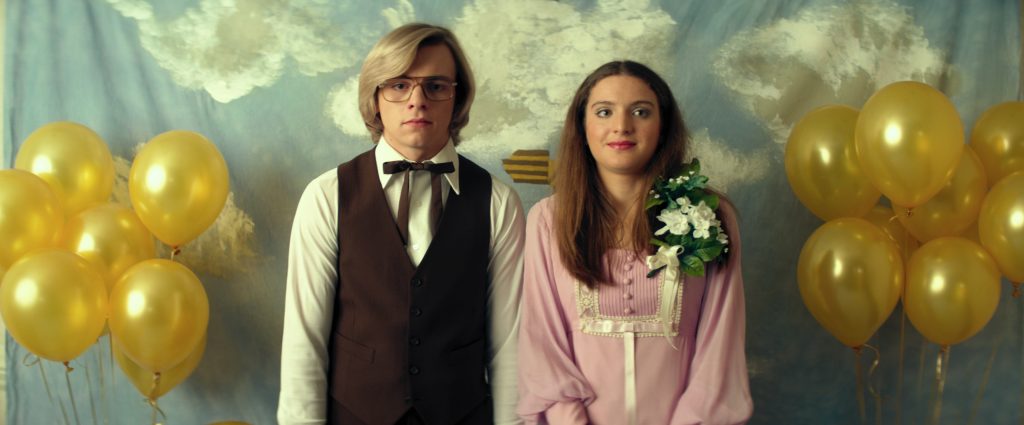
My Friend Dahmer is a difficult movie to review. I hesitated to publish this since I never in a million years thought that I would leave the film feeling sympathy for Dahmer, so much so that I couldn't stop thinking about him for days afterward. 

We all know the story behind Jeffrey Dahmer, the American serial killer and cannibal who murdered, raped, and chopped up the bodies of 17 young men between the late 70's and early 90's. The details of his killings are atrociously gruesome, enough to send shivers down the spine of anyone willing to dig deeper and learn more. What's even more chilling are the interviews with him afterward, the cool and collected demeanor of an absolute psychopath. 

Familiar with all this, I naturally went into Marc Meyers' My Friend Dahmer very curious. The film is based on a graphic novel of the same name, which was written by Dahmer's high school acquaintance, John Beckderf. It chronicles the last two years of Jeffrey Dahmer's high school life, ending just before he claims his first victim.

When we first meet Dahmer (played by the fantastic Ross Lynch), he's a complete loner at school, with a hunched posture and sullen disposition. His home life is a wreck with his parents arguing repeatedly, and his mother who appears to have a bipolar disorder and addiction to pills. He takes solace in collecting and dissecting roadkill, mesmerized by the insides of these creatures. He suddenly acquires "friends" at school, one of them being John, who enjoy his ability to degrade himself and have random outbursts as pranks on schoolmates and the community. His friends slowly realize, however, that there is more than just these outbursts...there's something wrong with Dahmer. Once they start shunning him, he spirals into a slow alcoholism, and you see his mental state deteriorate and become increasingly more disturbing. 


Now, because the film ends just before Jeffrey commits his first crime, you don't see any of the murders. You see Dahmer before he becomes the historic villain we've already been acquainted with. Because of this, Marc Meyer's does a fantastic job of humanizing the character. There are instances where Dahmer is just a regular teenager, from mocking his mother's interior designer, being on a class trip and trying to make new friends, to even asking a girl out to prom, you forget who Jeffrey Dahmer is. Even the title of the film itself is almost endearing. Before watching My Friend Dahmer I remember thinking, "how can anyone think of Dahmer as their friend?" Afterwards, you realize that once upon a time he was, in fact, someone's friend, a suburban teenager before any crimes were committed. All of this makes you wonder, what if someone reached out to him and simply asked him if he was okay, would it have changed anything? Would the outcome have been any different? You almost feel sorry for him, conflicted with emotions since you know exactly who he is. 

I think it's phenomenal that Meyers decided to skip the inclusion of any of the murders. It would have almost felt like a cop-out. You do see two very intense and close encounters, leaving you at the edge of your seat. My Friend Dahmer is definitely slow but extremely powerful. Ross Lynch does such a fantastic job at picking up on Dahmer's traits and getting into the character's mind completely. It's also chilling to know that the scenes in Jeffrey's house are actually shot in the real home he ends up killing his first victim in. 

I highly recommend seeing this indie gem wherever you can, as it's an extremely intimate and despairing portrait of someone beyond hope or help. My Friend Dahmer is the ideal opportunity to question your own emotions and the compassion you'll inevitably feel, something that I'm still struggling coming to terms with. As Nietzsche once wisely put it, "Whoever fights monsters should see to it that in the process he does not become a monster. And if you gaze long enough into an abyss, the abyss will gaze back into you."


SHARE:

Tuesday, May 23, 2017

Twin Peaks: The Return - David Lynch at his Finest


It's hard to believe that after 25 years, Laura Palmer has kept her promise to the world, and David Lynch has once again invited us back to the strange yet beautiful world of Twin Peaks. The show aired on Sunday with the first two episodes, followed by the next two available On Demand immediately after, die hard Peaks fans are finally able to get some questions answered. The biggest one being, what happened to Dale Cooper, and has he been stuck in the Black Lodge for the past 25 years?!

Being a post on my all-time favourite show, I'm going to do Lynch the justice of not giving anything away, but to review elements of this premier that I think were fantastic. Lynch does a wonderful job of starting off glacially, some scenes move so slow and yet you can't bring yourself to look away in case you miss anything. The trademark Lynchian touch is littered throughout, with very long pauses and stares between characters, bizarre dialogue, accompanied with the occasional staple long shots of empty hallways.

Watching Twin Peaks, it's interesting to note that it has characteristics of his more experimental films like Mulholland Drive, and less like the original Twin Peaks or Blue Velvet. We get no jazzy soundtrack we're used to. In fact, the silence in the first two episodes is absolutely unnerving. We have less of that soap-opera style dialogue that was so dear to the original Twin Peaks. After watching the first four episodes it can only be described as a sensory overload, an absolute experience that sucks you in entirely. Some of the scenes are so bizarre and so out there, that you have to just let go of any sense of logic and go with it.


As for the familiar faces? Seeing them brings shivers up your spine, and it's all tinged with a hint of sadness. Jerry and Ben are back, offering up some witty banter, and you see that Ben is still running the Great Northern. Seeing Lucy and Andy is also wonderful, and they're still working at the Sheriff's Department. It's like everything has been stuck in time, and in a way it's all beautiful. Hawk is still Deputy, and his exchanges he has with the Log Lady (the late Catherine E. Coulson who passed away shortly after filming her scenes in 2015) are heartbreaking. She's so frail, and every time you hear her and Hawk say their goodbyes via phone, you end up with a lump in your throat. It goes to show that even in Twin Peaks, nothing is eternal, and everyone ages. We also run into Shelly and James, as adults, at the Roadhouse. Seeing all these familiar faces will strike a chord, you absolutely better believe it. I felt a sense of nostalgia, and couldn't believe everyone was back.

Also to note in that phenomenal scene at the bar, Portland-based band Chromatics take the stage instead of Julee Cruise in the original. They preform Shadow, a song that rivals Julee's Falling. It has the same bittersweet vibes, and as Shelly and James spot each other across the bar, it's magical and absolutely perfect. I was so happy to see this collaboration (Johnny Jewel's album that he just released recently features a plethora of songs that will be in the series), because I feel like they're the perfect group for this bizarre and twisted world. Bittersweet and airy music has never been more fitting, and it gives off all the feels. 


We finally get to see what happened to Cooper as well, and lo and behold, he's still trapped in the Black Lodge. Meanwhile, his doppleganger is out in the real world not treating Coop's body too well, with long greasy hair and a couple extra pounds. This evil version of Cooper is also terrifying. With gruesome murders being committed, and some that we get to experience ourselves, we're left hoping and praying that the original Dale Cooper gets to leave the Black Lodge, and find his way back to Twin Peaks.

All in all, the premier was everything I wanted it to be. I think Lynch did a perfect job starting off at such a gradual pace. He's mentioned himself that this Twin Peaks shouldn't be viewed as a series, but as a long, 18 hour film. Seeing all the familiar faces was such a wonderful treat, and you just can't believe that it's all happening again. The iconic theme song pulls you in and really drives the point across that Twin Peaks is back. With the theme playing over a faint photo of Laura Palmer's prom photo, you realize that 25 years later, the show is equally impactful and meaningful as it was before, telling you that it still has the power to commandeer the world and grab your attention, time future, or time past.

///

Catch Twin Peaks Sundays at 9c on Showtime.
SHARE:
© Paradise Playground. All rights reserved.
BLOGGER TEMPLATE DESIGNED BY pipdig